
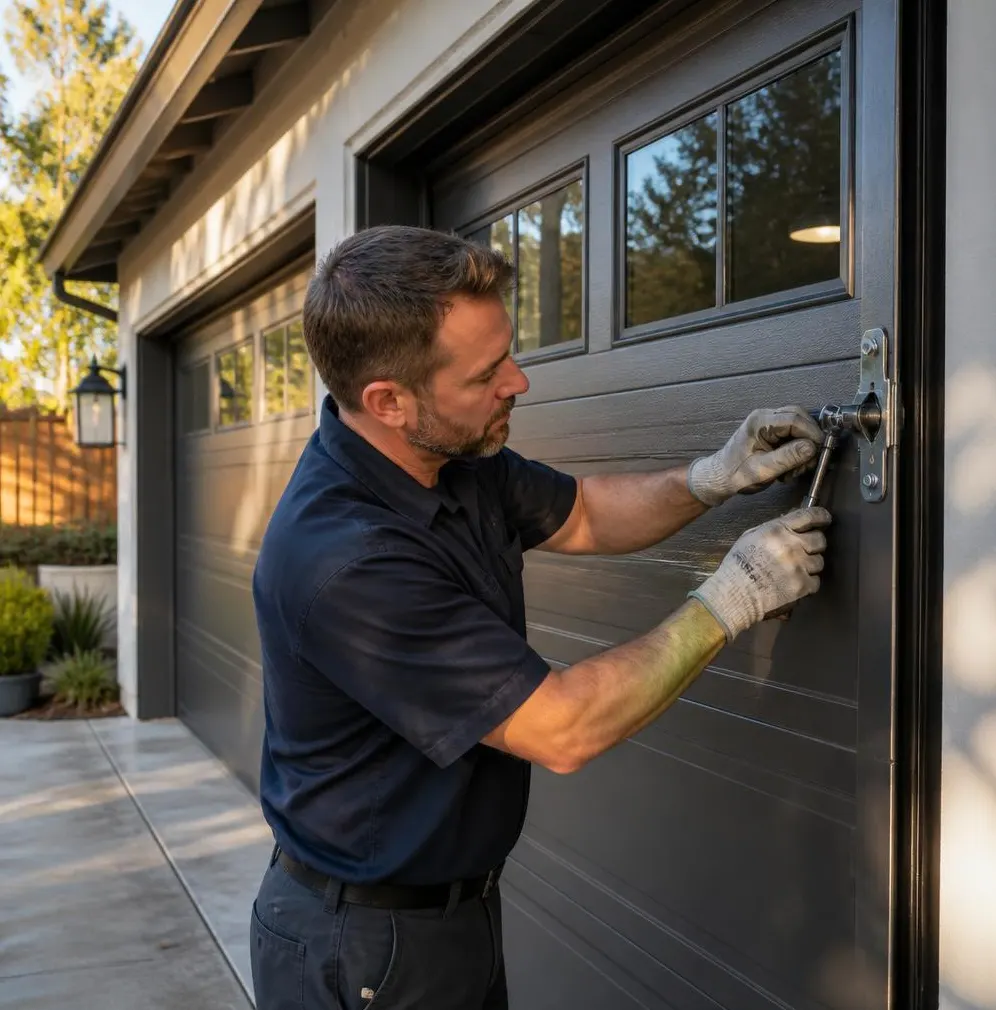
What We See on These Calls
This is one of the most common service calls we get this time of year. A homeowner presses the button, the door starts down, and a foot or two from the floor it stops and goes right back up. Or the door won't move at all, the opener just hums, or the wall button does nothing and the remote gets no response. Sometimes there's a blinking light on the opener head or on a small box near the floor by the tracks. Almost none of these problems are random, and almost all of them have a clear cause once you check things in the right order.
Start With the Safety Sensors
Every garage door opener built in the last few decades has two small sensors mounted a few inches off the floor on either side of the track. If anything blocks the invisible beam between them, or if they're knocked even slightly out of alignment, the opener will refuse to close the door or reverse it mid-close as a safety measure. This is the single most common cause of a reversing door.
In fall, cobwebs, dust, and condensation on the lenses are frequent culprits, especially on cooler, humid mornings when moisture settles on everything overnight. A stray leaf blown in by wind, a bike leaned against the track, or even a dropped tool can trip the sensor too. Check that both sensor lights are solid and not blinking, wipe the lenses with a soft cloth, and make sure nothing is in the beam's path. If one sensor has been bumped loose, it needs to be realigned so both units face each other squarely.
Check the Tracks and Rollers for Obstructions or Misalignment
Next, look at the tracks themselves. Wind-blown debris, dropped acorns, or small objects can lodge in the track and cause the door to bind as it travels, which the opener may read as resistance and respond by reversing. A bent section of track, often from a car bumper or ladder bump, will cause the same symptom in the same spot every time the door runs. Clearing debris is simple. A bent track usually needs to be straightened or, if it's badly dented, replaced so the rollers can move freely again.
Inspect the Opener's Close-Force and Limit Settings
If the sensors and tracks check out, the next thing a technician looks at is the opener's limit and force settings. These tell the unit how far to travel and how much resistance to tolerate before assuming it's hit an obstruction. Big seasonal temperature swings, like the ones this area sees heading into winter, change how stiff the grease in the rollers and hinges gets, and that can shift how much effort it takes to close the door. If the force setting is too sensitive, a door that closed fine in September can suddenly start reversing in November. This is a straightforward adjustment, but it should be set carefully, since setting the force too high defeats the safety feature it's meant to provide.
Look at the Springs
If the door feels heavy, closes slower than usual, or the opener strains audibly before reversing, worn springs are often the real issue. Torsion and extension springs lose tension over years of cycling, and when they can no longer properly counterbalance the door, the opener has to work harder than it was designed to, which it interprets as hitting something. The humid summers and hard winter cold here both add stress to spring steel over time, and a spring that's close to failing is also a spring that can snap suddenly. Spring replacement isn't a do-it-yourself repair; these components are under heavy tension and are normally replaced in pairs by a technician with the right bars and clamps.
Check Rollers, Hinges, and Cables for Wear
Rusted or worn rollers, stiff hinges, and fraying lift cables can all cause a door to bind partway through its cycle. Road salt and winter moisture tracked into a garage accelerate rust on these parts faster than most homeowners expect. A technician will spin each roller by hand, check hinges for play, and look over the cables for broken strands. Worn parts get lubricated or replaced, and this kind of basic maintenance is also one of the best ways to prevent a reversing-door call in the first place.
Opener Circuit Board or Wiring Issues
If everything mechanical checks out and the door still won't respond or behaves erratically, the opener's logic board or sensor wiring may be the problem. Moisture intrusion, a loose wire nicked during other garage work, or damage from a storm-related power surge during spring storm season can all cause a board to misread signals. This is usually diagnosed by testing the board directly and ruling out everything else first, since board failure is less common than a dirty sensor or a worn spring but does happen.
When to Call Frankfort Overhead Door Co
If you've cleaned the sensors, cleared the tracks, and the door still reverses or won't move, it's time to call. We offer Garage Door Repair for exactly this kind of diagnostic work, tracing the issue from sensors through to the opener itself, and Spring Replacement when worn springs are putting unsafe strain on the system. We serve Frankfort and the surrounding area including Lexington, Georgetown, Lawrenceburg, Versailles, Shelbyville, Midway, and Nicholasville.
If your garage door in Frankfort, KY is giving you trouble, give Frankfort Overhead Door Co a call and we'll get it diagnosed and fixed right.